Imagine Worldwide
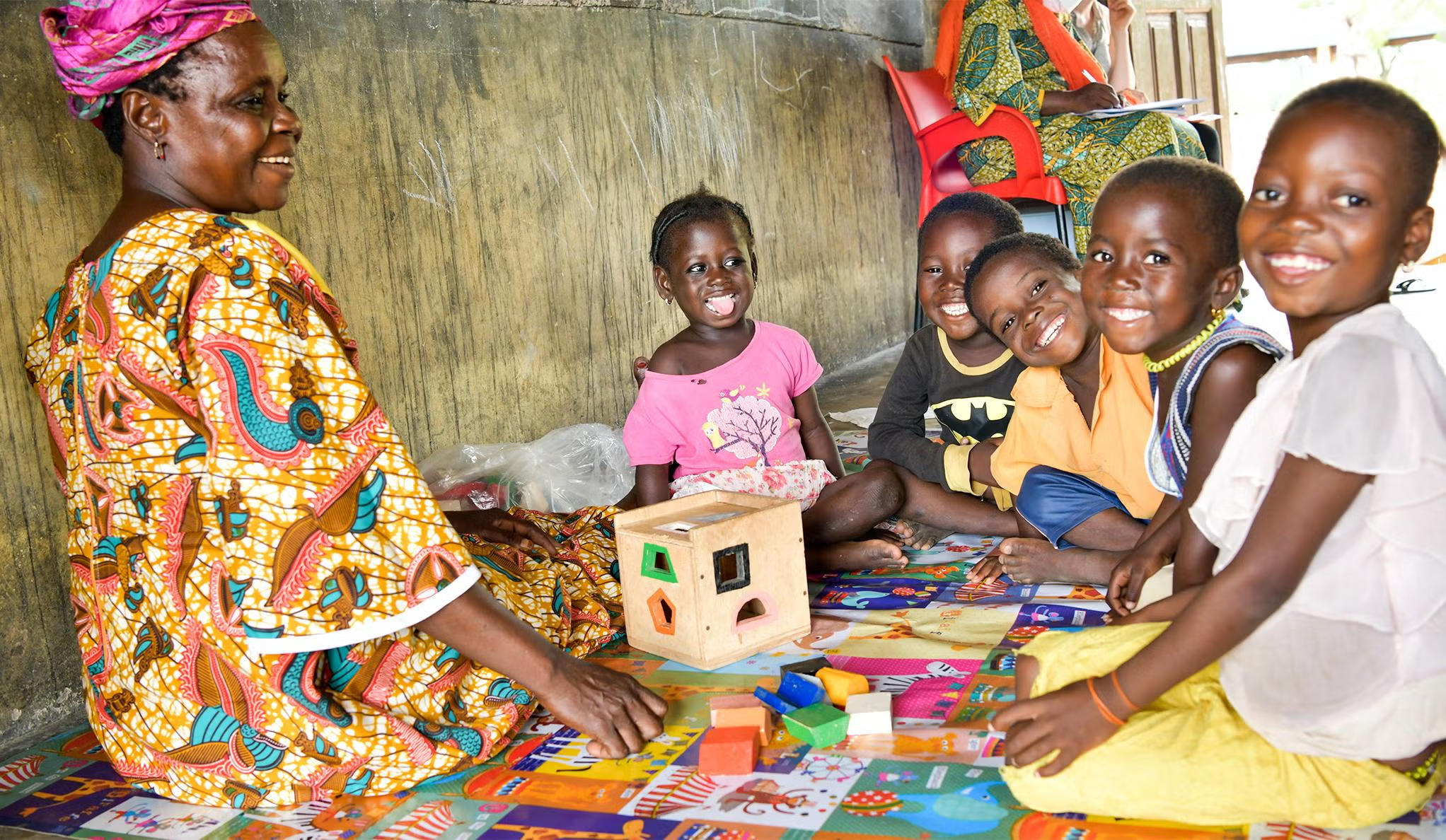
Children in Africa end up in overcrowded classrooms with under-resourced teachers—with predictable results.
The Idea
Tablet-Based Learning
Fellow

Susan Colby
Current Leader

Rapelang Rabana
Mulago Lead
s


Total Investment
2350000
Grants
0
Equity/SAFE
0
Debt/Convertible Debt
Funded Since
2018
Geography
Sector
Structure
The Mission
Get kids to grade-level reading and math.
How It Works
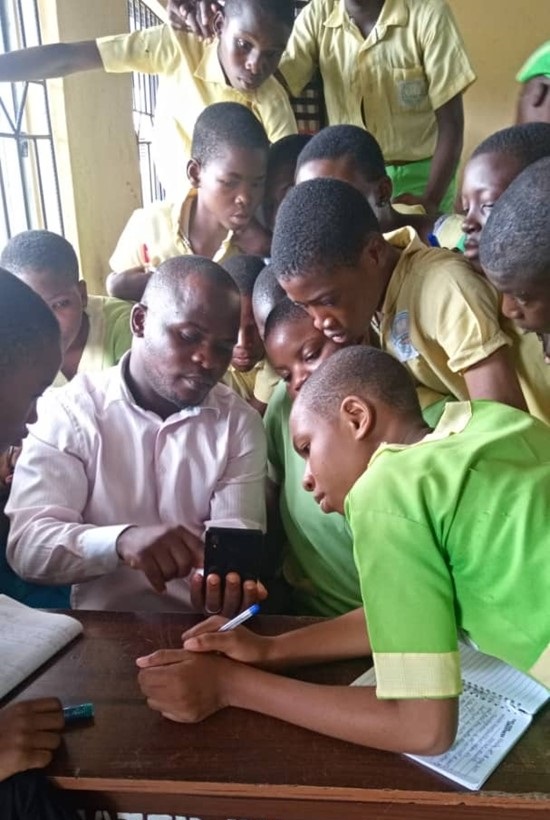
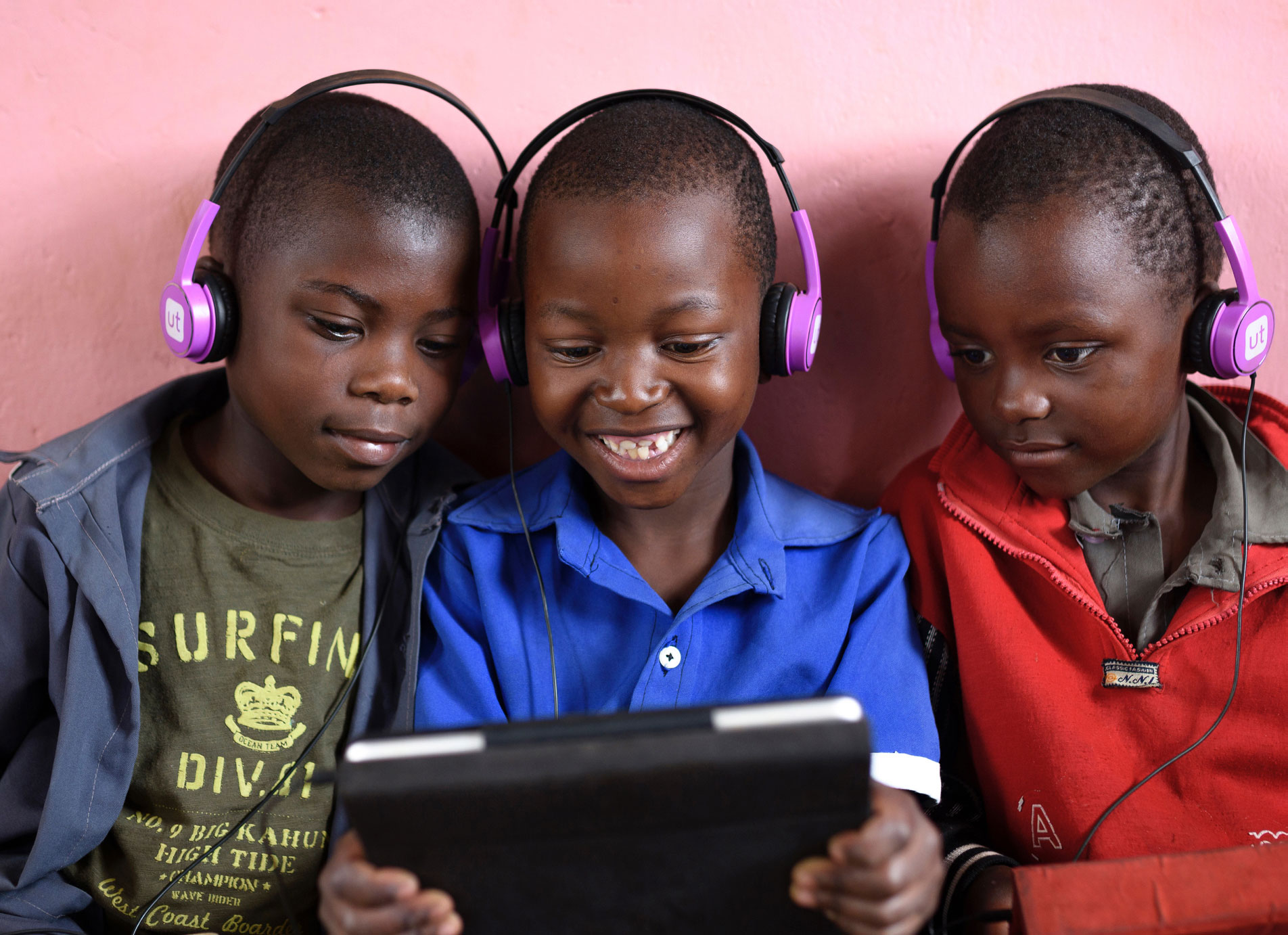
Imagine equips schools with 1) durable tablets and headphones, 2) solar power and charging systems, 3) adaptive, personalized learning software, and 4) training for teachers to run it. Kids use tablets for 30–45 minutes per day at their own pace.
The Dream
African governments buy and use tablets equipped with software (from an edtech marketplace).
Why We're In
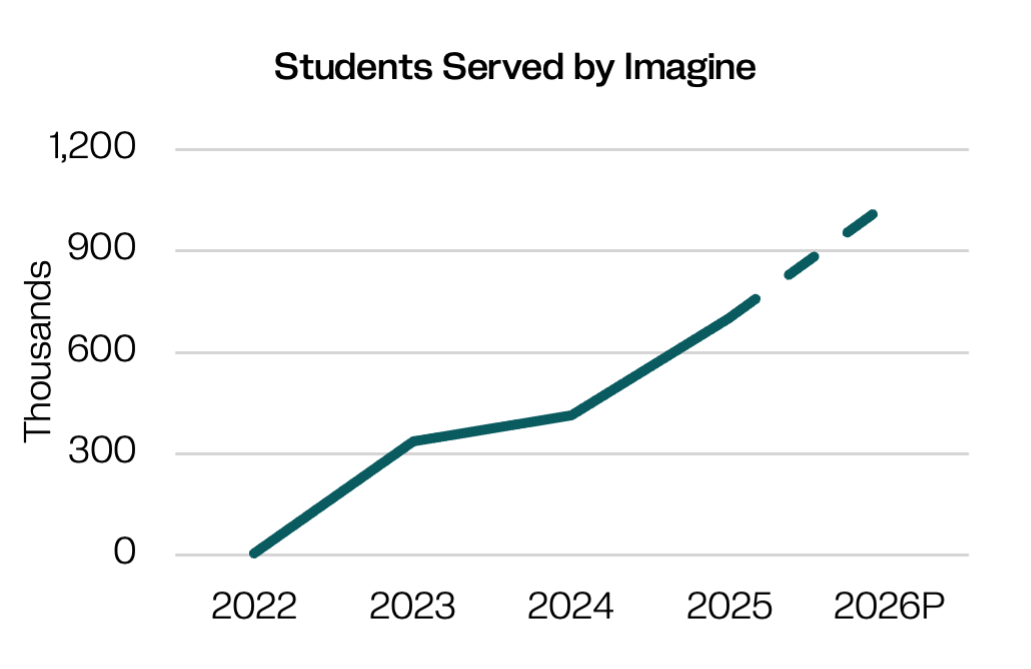
Edtech solutions haven’t lived up to the hype in Africa. This one does. Imagine’s kids are on track in reading and math at rates >50% over peers, and compounding effects plus adaptive software can drive that much higher. Imagine is on track to serve 1M kids this year, with governments increasingly managing delivery. They’ve successfully raised a lot of philanthropy money for upfront investment, but the recurring $3 per kid per year cost is designed for strapped governments. We’re betting that African governments will carry the torch and pay for tablet-based learning at scale.
The Model
A solution that works and can scale.
Invincible hardware and power
Imagine procures and provides a bundle for each public primary school which includes durable and affordable tablets with headphones. Solar panels are also installed at each school to charge the tablets and broader school community.
Adaptive software
Tablets come with onebillion’s self-paced, adaptive, and engaging literacy and numeracy software. The software works offline and is adapted for different languages and cultural contexts.
Classroom delivery
Government teachers are trained to manage the charging of devices and ensure that children get sufficient dosage (30-45 min/day).
Maintenance
Imagine works through local partners and the government to install and manage the infrastructure. Usage is tracked remotely to triage issues weekly.
Potential for Impact at Scale
Mulago uses four criteria to gauge potential for exponential impact. The model must be:
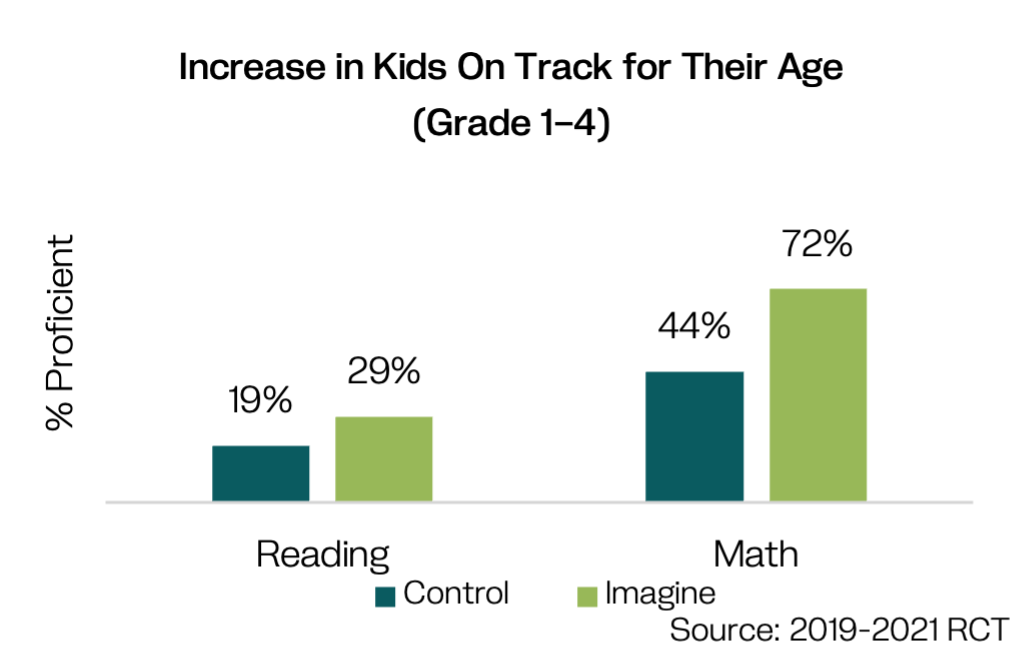
This is about impact and evidence. A 2-year randomized control trial in Malawi (their 9th RCT), showed 72% of kids were on track in math vs. 44% for control, and 29% in literacy vs. 19% for control (correlates to an effect size of 0.54 SD in math, 0.37 in literacy). An even bigger, 3rd-party RCT in Malawi (funded by the World Bank) is wrapping up in 2026. Imagine’s latest internal results show that among 4th graders in Malawi, 49% were on track in math (up from 32%) and 61% in reading (up from 36%) after 1 year.
This is about scope. 90% of children in Sub-Saharan Africa do not have basic literacy and numeracy skills. Schools are overcrowded with underqualified teachers and insufficient instructional materials. Imagine’s core countries for scale are Malawi, Sierra Leone, and Tanzania. The model can work in other places if there’s a big upfront investment from philanthropy/big aid for infrastructure, training, and implementation. Once deployed, the governments’ ability to monitor/triage issues and ensure sufficient dosage are key constraints.
This is about whether government can deliver the model. Imagine with their suppliers procure and install the tablets and surrounding infrastructure in schools (>1,000 schools in 3 countries). They train and oversee a network of local and government partners to manage implementation and monitoring. Imagine still does most of this but is transitioning its first cohort of 500 schools in Malawi to full government ownership in 2026. How governments manage the complexities of triage, repairs, and dosage at scale remains a question.
This is about what the model costs if delivered and paid for by government. The recurring cost to government customers is ~$3/child/year in Malawi (vs. ~$50/child/year government budget) and up to ~$5/child/year in other countries. The upfront investment is ~$7-8/child/year which is currently fronted by a combo of philanthropy and big aid. While governments aren’t yet payers, they’re on the hook to begin to cover recurring costs after 2-3 years. If they don’t, external funding for countrywide scale up will be paused.
.png)
Imagine is on the cusp of scale as they deploy their solution nationwide across 3 countries.
Our Take
In 2026, Imagine will surpass 1M annual students with rigorous evidence of meaningful academic gains, which they hope to further validate with an ongoing, much larger RCT. We still have (shared) big questions on 1) governments’ ability to manage schools and maintain quality without Imagine and 2) governments’ long-term willingness to pay amidst large philanthropic investment, even if it’s cheap on paper.
Are you a serious funder and want to learn more?
This is just a snapshot of what we know about the organization. If you're an investor or funder that might send some serious dough their way, we're always delighted to share more. Reach out and we'll connect you with the right person on our team.
*this is not monitored for funding requests.
.jpeg)